
Knowing God’s Word is important but knowing it is not the same as living it. The Bible was not given simply to increase our knowledge. It was given to transform our lives.
A person can read Scripture regularly, know biblical language, listen to sermons and even understand sound doctrine, yet still fail to live according to what God has said. Scripture repeatedly challenges believers to move beyond hearing into obedience.
This is the heart of what it means to do it the Bible way.
The Christian life is not about choosing what feels right, what is popular or what produces the easiest outcome. It is about allowing God’s Word to shape how we think, what we believe, how we behave and the decisions we make.
Psalm 119:105 declares: “Your word is a lamp for my feet, a light on my path.”
God’s Word provides direction. But a lamp is only useful when we are willing to walk in the light it provides.
Hearing the Word Must Lead to Doing

James gives one of Scripture’s clearest challenges concerning obedience. In James 1:22-25, believers are told not merely to listen to the Word but to do what it says.
James compares someone who hears God’s Word but does not obey it to a person who looks at their face in a mirror and immediately forgets what they look like. The image is powerful because a mirror reveals what needs attention. But seeing the problem without responding to it achieves very little.
The same is true of Scripture.
God’s Word reveals our hearts, exposes attitudes, motives, behaviours and priorities that need to change. But Scripture is not intended merely to make us aware of our shortcomings; it calls us to respond.
We can:
- Read the Word and still refuse to follow it.
- Understand the Word and still choose our own way.
- Believe the Word and still fail to put it into practice.
- Do the Word by allowing God’s truth to shape our everyday lives.
The goal is not simply to become people who know Scripture; it is to become people whose lives increasingly reflect Scripture.
Jesus made the same point in Matthew 7:24-27. He describes two people who hear His words. The difference between them is what they do with what they have heard.
The wise person hears Jesus’ teaching and puts it into practice. Jesus compares that person to someone who builds a house on rock. When the storms come, the house stands because its foundation is secure.
The foolish person also hears. The difference is that they do not act.
This teaches us something important: hearing God’s Word without obedience creates no lasting foundation.
Joshua was given a similar instruction when he prepared to lead Israel into the Promised Land. In Joshua 1:8, God told him to keep the Book of the Law close, meditate on it day and night, and be careful to do everything written in it.
There is a clear progression: Know it. Meditate on it. Do it.
God’s Word was never intended to remain on the page. It was meant to become visible in the lives of His people.
Obedience Is the Response of a Believer Who Loves Christ
It is important, however, to understand what biblical obedience is and what it is not.
Christianity is not simply about following rules.
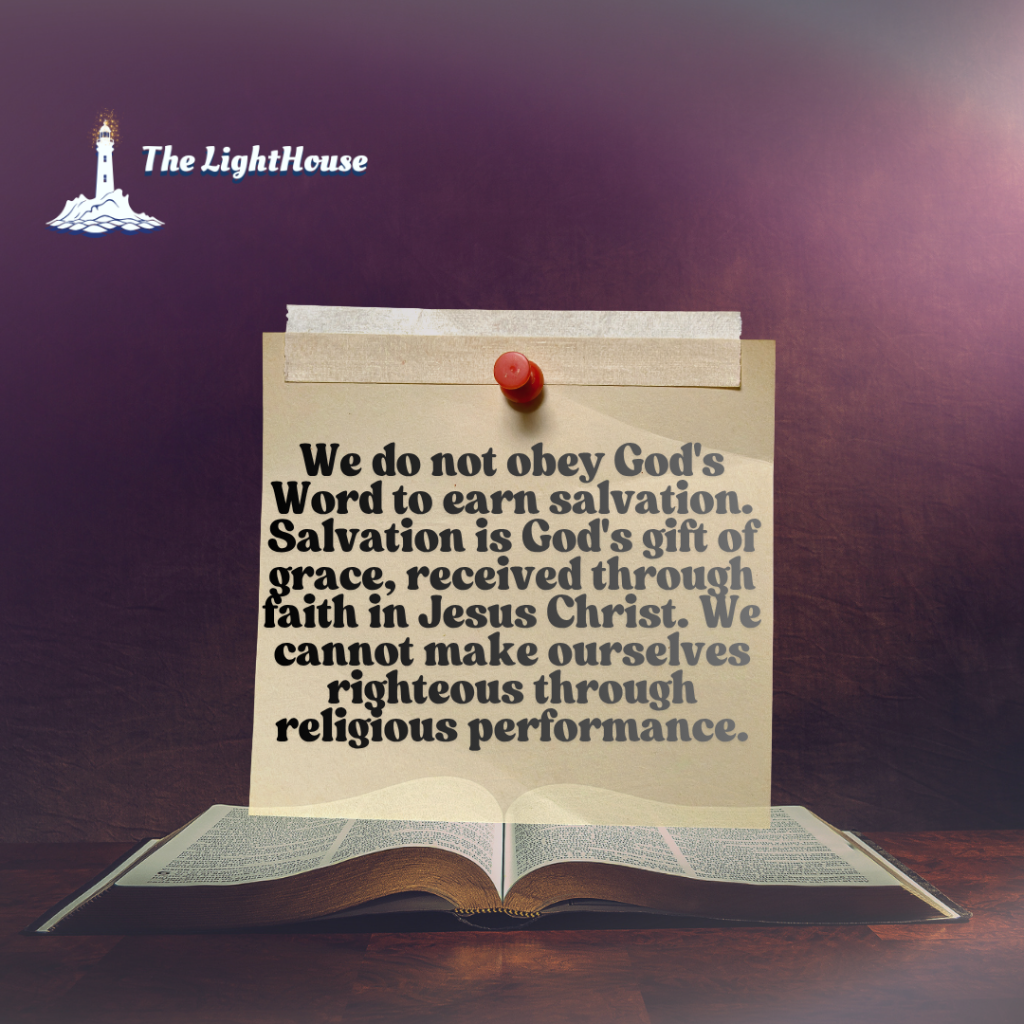
We do not obey God’s Word to earn salvation. Salvation is God’s gift of grace, received through faith in Jesus Christ. We cannot make ourselves righteous through religious performance.
Instead, obedience is the response of someone who has already received God’s grace.
Jesus said in John 14:15: “If you love me, keep my commands.”
Jesus connects love and obedience. Obedience is not just about following instructions because we are afraid of punishment. It flows from a relationship with Christ.
When we understand what Christ has done for us, our response should be surrender.
We obey because we trust and love Him.
We obey because His ways are better than our own.
This is why biblical obedience should never become legalism. Legalism attempts to earn God’s acceptance through works. Biblical obedience responds to God’s grace with a surrendered heart.
There is a profound difference between saying:
“I have to do this so God will accept me,”
and saying:
“Because God has accepted me through Christ, I want to live in a way that honours Him.”
The first produces striving, while the second produces gratitude.
Doing it God’s way therefore requires trust. There will be times when God’s instructions challenge our preferences. There will be moments when obedience costs us something. We may not always understand why God has given a particular instruction, but obedience means trusting His wisdom above our own.
This affects every area of life:
- Our relationships: we choose forgiveness, honour and love.
- Our speech: we become careful with our words.
- Our choices: we ask what pleases God rather than what simply benefits us.
- Our priorities: we make room for God rather than fitting Him around everything else.
- Our character: we pursue holiness even when nobody else is watching.
This is what it means to walk according to God’s Word.
It is not perfection. Believers will stumble, make mistakes and need correction. But a life surrendered to Christ increasingly becomes a life shaped by His truth.
When Scripture challenges our preferences, we do not rewrite Scripture to accommodate ourselves. We allow Scripture to correct us.
That is what it means to do it the Bible way.
Conclusion
The Christian life calls us beyond simply knowing God’s Word. We are called to live it.
We do not obey to earn salvation, rather, we obey because we have been saved.
There will always be easier ways, more popular ways and ways that seem more convenient. But the safest way for a believer is God’s way.
When we choose to do it the Bible way, we are choosing to trust God’s wisdom over our own, His truth over our feelings, and His will over our preferences.