
Life is marked by constant change. Circumstances shift unexpectedly. Seasons of joy give way to seasons of difficulty. Emotions rise and fall. Relationships evolve. Cultures transform. Even our own perspectives and priorities can change over time.
Yet amidst a world defined by uncertainty, Scripture points us to a remarkable truth: God does not change.
This is beautifully captured in Hebrews 13:8: “Jesus Christ is the same yesterday and today and forever.”
For believers, this verse is more than a comforting statement, it is an anchor. While everything around us may be subject to change, Christ remains constant. His character does not fluctuate. His promises do not expire. His faithfulness does not diminish.
Our walk with God may fluctuate, but God does not. Our faith may be tested, but God remains faithful.
The theological term for this truth is the immutability of God – His unchanging nature. It is one of the most important attributes of God because it assures us that the God we trust today is the same God who has always been and always will be.
The Unchanging Nature of God
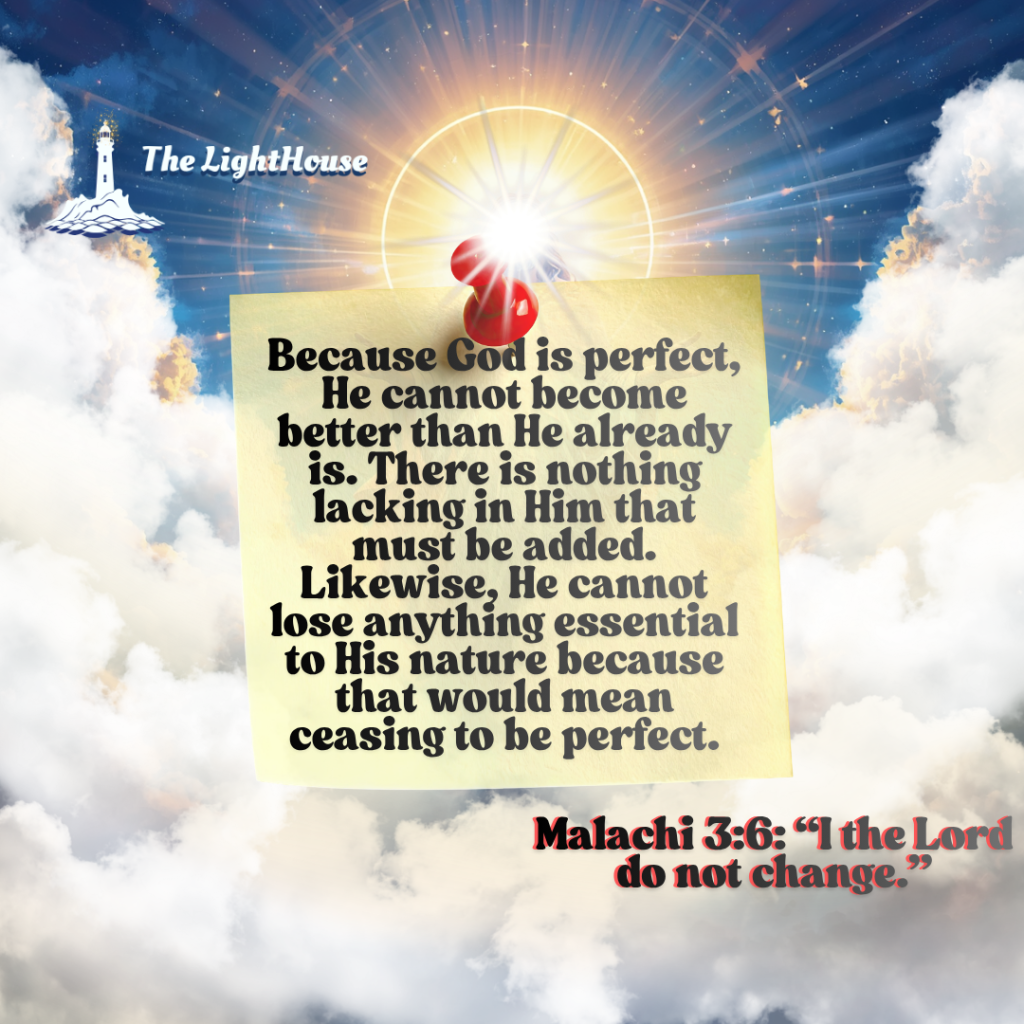
The immutability of God is clearly taught throughout Scripture. God Himself declares in Malachi 3:6: “I the Lord do not change.”
This statement is both simple and profound. God does not evolve, improve, weaken, or become something different over time. Unlike humanity, He is not influenced by changing circumstances or external pressures.
Similarly, James 1:17 describes God as the giver of every good and perfect gift and says that with Him there is “no variableness nor shadow of turning.” In other words, there is no inconsistency in God. He is not unstable.
This truth is rooted in God’s perfection.
For change to occur, one of two things must happen:
- Something needed is gained, resulting in improvement.
- Something valuable is lost, resulting in decline.
Neither possibility applies to God.
Because God is perfect, He cannot become better than He already is. There is nothing lacking in Him that must be added. Likewise, He cannot lose anything essential to His nature because that would mean ceasing to be perfect.
God’s unchanging nature is also connected to His eternity. Scripture teaches that God exists outside the limitations of time. Passages such as Psalm 90:2 and 2 Timothy 1:9 reveal a God who transcends the boundaries of past, present, and future.
Because God is eternal:
- His wisdom never becomes outdated.
- His purposes never need revision.
- His truth never loses relevance.
- His power never diminishes.
- His nature never changes.
This is why Scripture confidently states in Numbers 23:19: “God is not a man, that He should lie, nor a son of man, that He should change his mind. Does He speak and then not act? Does He promise and not fulfil?”
Unlike human beings, whose plans often change because of limited knowledge or unforeseen circumstances, God possesses perfect knowledge and complete sovereignty. He never needs to adjust His purposes because nothing catches Him by surprise.
Finding Assurance in an Unchangeable God
The immutability of God is not merely a theological concept; it is a source of comfort and assurance.
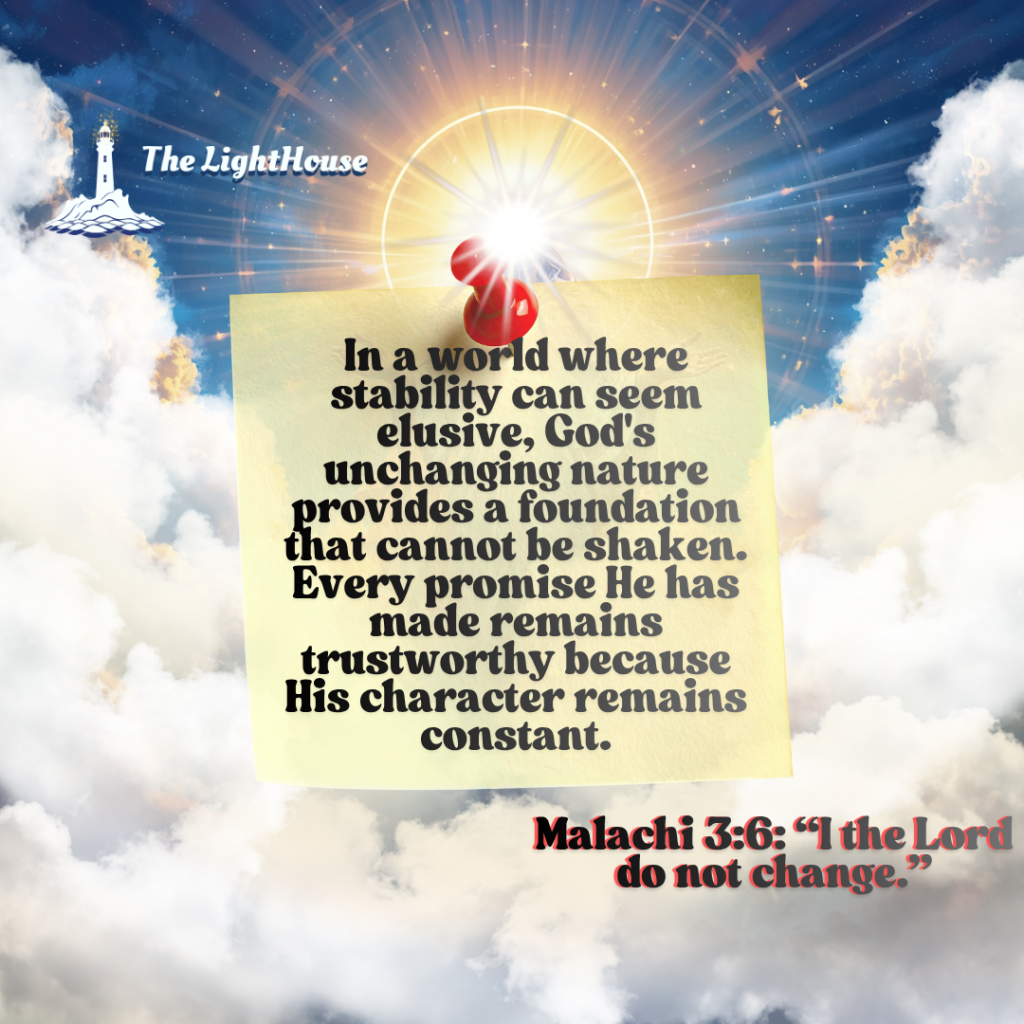
In a world where stability can seem elusive, God’s unchanging nature provides a foundation that cannot be shaken. Every promise He has made remains trustworthy because His character remains constant.
This means that as believers, we can live with confidence, not because circumstances are predictable, but because God is dependable.
God’s unchanging nature guarantees that His:
- Character remains constant: God is always holy, righteous, merciful, and just. He never acts contrary to His nature.
- Promises remain trustworthy: What God has spoken, He will accomplish. His Word does not fail.
- Love remains steadfast: God’s love is not based on mood, circumstance, or human merit. It flows from His unchanging character.
- Faithfulness remains certain: God never abandons His people. He remains faithful even when believers struggle.
- Purposes remain secure: God’s plans cannot be frustrated or overturned. What He has ordained will come to pass.
The believers’ confidence ultimately rests not in the consistency of their own faith but in the consistency of God Himself.
Because God does not change:
- His promises remain trustworthy.
- His salvation remains secure.
- His purposes remain certain.
- His love remains steadfast.
This assurance extends to salvation itself. Believers are not saved because of their ability to maintain perfection, but because of the finished work of Christ. The same Jesus who saves is the Jesus who sustains.
The declaration of Hebrews 13:8 reminds us that the Christ who called His disciples, healed the broken, forgave sinners, and conquered death remains unchanged today. His compassion is unchanged. His power is unchanged. His grace is unchanged.
That gives us believers confidence to face both present challenges and future uncertainties.
Conclusion
The doctrine of God’s immutability is one of the most comforting truths in Scripture. In a world where change is constant, we can rest in the certainty that God remains the same.
Malachi 3:6, James 1:17, and Hebrews 13:8 all point to the same reality: God is unchangeable.
His character remains constant. His promises remain true. His holiness remains pure. His love remains steadfast. His faithfulness remains sure.
The believer’s hope is not anchored in the shifting realities of life but in the eternal God who never changes. Because He remains the same yesterday, today, and forever, we can trust Him completely, follow Him confidently, and rest securely in His unfailing love.